What Happens When Employees Take the Lead: A Pilot in Practice
In a recent pilot program, the ambition was not to introduce another initiative.
It was to create the conditions for engagement — allowing employees to shape what happened within them.
The Approach
Rather than relying solely on top-down activities, the program was built around three core elements:
A clear 3-week framework — consistently communicated and aligned with the organization’s culture
A curated mix of activities — designed to meet different needs and preferences
Space for employees to take initiative — and actively shape the experience
A balance of structure and ownership
The program combined curated sessions with employee-led initiatives.
Curated elements included:
Physical activities, yoga, and mindfulness
Educational sessions on stress, recovery, and health
Workshops on self-leadership and sustainable ways of working
Social and environmental initiatives
Gamified team challenges
At the same time, employees expanded the program through their own initiatives — from wellness sessions throughout the day to department-led fundraising activities.
This balance allowed the program to evolve organically, shaped by how people chose to engage.
From program to platform
Rather than a fixed initiative, it became a platform.
One that supported not only health, but also connection, learning, and shared purpose — something people could step into and build together.
Partnerships with local gyms and brands further strengthened the experience through sponsored sessions and products.
Social impact and collective purpose
The program extended beyond individual wellbeing to include fundraising, volunteering, environmental actions, and participation from employees and their families.
This added an important dimension — connecting wellbeing with purpose and shared impact.
What made it work
The impact came from the combination of:
Structure and flexibility
Organization and ownership
Individual engagement and collective purpose
Most importantly:
Employees were not just participants.
They helped create the experience.
Final reflection
Engagement cannot be forced. But it can be designed for.
When people are given both structure and the space to contribute, engagement doesn’t need to be driven — it builds naturally through participation and shared ownership.
When Wellbeing Works Best: Make It Engaging, Social — and Employee-Led
Workplace wellbeing programs often aim to improve health, reduce stress, and strengthen engagement. But one element is frequently underestimated:
They should also be enjoyable.
Because when something feels energizing, social, and meaningful — people don’t just participate.
They want to.
Moving Beyond Top-Down Initiatives
Many wellbeing programs are designed centrally and delivered to employees.
While this can create structure, it can also create distance.
Participation becomes something expected, rather than something people feel connected to.
The shift happens when employees are not just participants — but contributors.
Why Ownership Changes Everything
When employees are given space to shape initiatives themselves, something important happens:
engagement becomes intrinsic
participation feels more natural
activities reflect real interests and needs
connection between colleagues strengthens
Instead of a program being “offered,” it becomes something the organization creates together.
The Role of Fun — Often Overlooked, Always Powerful
There is sometimes hesitation around making workplace initiatives “too light” or “too social.”
But enjoyment is not at odds with impact.
In fact, it is often what drives it.
When wellbeing activities include elements of fun:
energy increases
barriers to participation decrease
people connect across teams and roles
positive habits are more likely to stick
Whether it’s team challenges, shared experiences, or informal activities — these moments create a different kind of engagement.
One that feels human.
Employee-Led Initiatives in Practice
Some of the most successful programs include elements that are initiated or driven by employees themselves.
This can look like:
colleagues organizing group workouts before or after work
departments creating their own fundraising or volunteering initiatives
informal challenges that build momentum across teams
employees inviting speakers or topics they care about
These initiatives don’t require large budgets or complex structures.
They require trust, space, and encouragement.
A More Sustainable Approach to Engagement
When programs combine structure with employee ownership, they become more than a series of activities.
They become part of the culture.
participation feels organic, not forced
engagement spreads through teams, not just from leadership
wellbeing becomes something people actively shape
And importantly — it becomes sustainable over time.
Final Reflection
Wellbeing programs are most effective when they meet people where they are.
Not only in terms of health needs — but in how they connect, engage, and find energy in everyday work.
When initiatives are:
thoughtfully designed
socially engaging
and open for employees to lead
They move from being “nice to have”
→ to becoming something people genuinely value.
And that’s where real impact begins.
Recovery Is Not About Stepping Away From Life
A common misconception is that recovery from stress is simply about rest.
But recovery is rarely about completely switching off.
It is about:
restoring balance
reconnecting with meaning
gradually rebuilding capacity
In a work context, this means creating conditions where employees can move between focus and recovery — rather than operating at a constant high level until exhaustion.
From Reactive to Proactive
The data makes one thing clear: waiting is costly.
Stress-related conditions alone account for approximately 22% of sick pay cases, highlighting the need for earlier intervention.
Preventing mental health challenges does not require complex systems.
It often starts with small, consistent actions in everyday work:
regular check-ins on how people are doing
noticing changes in behavior or energy
creating clarity in priorities
normalizing recovery and boundaries
following up on workload — not just outcomes
Small shifts in how work is led and structured can significantly reduce long-term risk.
Early Signals to Pay Attention to
Mental strain rarely appears overnight.
Common early signs include:
changes in engagement or energy
difficulty concentrating
increased fatigue
social withdrawal
working more evenings or weekends
recurring short-term absence
Recognizing these signals early makes it possible to act before the situation becomes more serious.
A More Sustainable View of Performance
A healthy, high-performing team is not about lowering ambition.
It is about creating the conditions for sustainable performance.
That includes:
clear structures
realistic expectations
access to support
time for recovery
When these elements are in place, wellbeing and performance are no longer competing priorities — they reinforce each other.
The Real Shift
The most important shift is this:
Mental health at work is not a separate initiative.
It is an outcome of how work is designed.
When organizations begin to see it this way, the focus changes:
From reacting to problems
→ to designing healthier ways of working
And that is where meaningful, lasting impact happens.
Final Reflection
Workplaces shape how people feel — every day.
That brings responsibility.
But also opportunity.
Because when people are supported in how they work, not just what they deliver, something shifts.
Energy returns.
Engagement strengthens.
Performance becomes more sustainable.
Not as an added benefit.
But as a natural result.
How AI Is Changing Work—and Why the Uncertainty Matters for Wellbeing
AI isn’t just changing what we do at work.
It’s changing how work feels.
The conversation often focuses on productivity, efficiency, and automation. But underneath that is something less discussed—and more immediate:
Uncertainty.
How AI is showing up in everyday work
For most people, AI isn’t a single shift. It’s a gradual, uneven change that shows up in different ways:
Tasks becoming automated or redefined
Expectations around speed and output increasing
New tools being introduced without clear guidance
Roles evolving faster than job descriptions
For some, this creates opportunity.
For others, it creates ambiguity.
And ambiguity is where wellbeing is most affected.
The wellbeing impact isn’t just about job loss
Much of the public conversation focuses on whether AI will replace jobs.
But in the near term, the impact is more subtle—and more widespread.
At the same time, the reality of redundancies in certain roles is becoming increasingly visible. Even when individuals are not directly affected, the awareness that roles can be reduced, restructured, or replaced creates a broader sense of uncertainty across teams.
This can show up as:
Cognitive load → people are constantly learning, adapting, figuring things out
Unclear expectations → what is “good enough” when AI is involved?
Loss of control → work processes shift without employees fully understanding how or why
Pressure to keep up → fear of falling behind, even among high performers
Job insecurity → concern about long-term relevance and stability
This creates a persistent, low-level stress that is difficult to name—but very real.
The psychology of the unknown
Uncertainty is one of the strongest drivers of stress.
When people don’t know:
how their role will change
what skills will matter
or what the future of their work looks like
…it becomes harder to feel:
secure
focused
or fully engaged
Even in high-performing environments, this can show up as:
hesitation
overworking to compensate
reduced confidence
quiet disengagement
Not because people lack capability—but because the ground is shifting.
The shift
AI is not just a technology shift.
It’s a human one.
The question isn’t only:
“How do we use AI?”
It’s:
“How do people experience this change?”
The takeaway
The unknown impact of AI is already affecting wellbeing—not only because of what has happened, but because of what might happen.
Organizations that recognize this early have an advantage.
Not just in adoption—but in engagement, trust, and long-term performance.
Because in times of uncertainty,
how people feel at work matters just as much as what they do.
Mental Health at Work — A Question of Leadership and Design
Mental health has become one of the most defining challenges in today’s workplaces.
Today, one in four employees reports experiencing health concerns linked to their work — often in the form of stress, worry, or anxiety. At the same time, 48% of long-term sick leave cases are connected to mental health.
On a broader level, the impact is significant. Mental health-related challenges are estimated to cost economies close to 5% of GDP annually, through lost productivity and absence.
But behind these numbers is something more human — a growing sense of pressure, mental load, and a gradual loss of energy in everyday work.
And importantly, the effects begin long before someone goes on sick leave.
They show up in:
reduced energy
lower focus
decreased engagement
strained collaboration
This is where organizations have the greatest opportunity to make a difference.
When We Act Too Late
Despite the scale of the issue, many organizations still respond only once problems have escalated.
Research indicates that 62% of companies act too late — often when an employee is already on sick leave or experiencing burnout.
This is rarely due to a lack of care.
More often, it’s because:
the signals are subtle
the pace of work is high
focus remains on delivery
But when action comes late, the consequences are more significant — both for the individual and the organization.
What could have been addressed early becomes something that requires long-term recovery and broader team adjustments.
What Mental Health at Work Is Really About
It’s easy to view mental health as an individual issue.
In reality, it is often shaped by the interaction between the individual and their work environment.
Work itself is not necessarily the problem.
In fact, 9 out of 10 individuals on long-term sick leave due to mental health report that work has contributed — but not simply because of workload alone.
Many people thrive under pressure, responsibility, and meaningful goals.
What makes the difference is what surrounds the work:
clarity in expectations
a sense of control
access to support
space for recovery
a culture where it feels safe to speak openly
When these elements are missing over time, the risk of mental strain increases — regardless of capability or ambition.
Talking About Mental Health — Simpler Than We Think
Many leaders hesitate to initiate conversations about mental health.
There’s often concern about:
saying the wrong thing
overstepping boundaries
needing to have all the answers
But in practice, it’s not about being an expert.
It’s about:
asking the question
showing awareness
listening without immediately trying to fix
Leaders are not expected to be psychologists.
But they play a critical role in creating an environment where it feels safe to speak about how work is experienced.
Often, that first conversation is what prevents a situation from escalating.
Stress — From Survival Advantage to Modern-Day Challenge
Stress is often framed as something negative.
In reality, it is one of the most important systems we have.
It is what allowed us to survive.
Built for Survival
For early humans, stress was immediate and physical.
A threat appeared — a predator, danger, uncertainty — and the body responded instantly. Heart rate increased, focus sharpened, energy surged. This fight-or-flight response helped us react quickly and stay alive.
Once the threat passed, the system reset.
Stress was:
short-lived
situational
followed by recovery
This cycle — activation and release — is what our biology is designed for.
The Modern Reality
Today, the nature of stress has changed.
The threats we face are rarely physical.
They are psychological, social, and ongoing:
constant connectivity
high cognitive demands
unclear expectations
sustained pressure without clear endpoints
The body, however, responds in much the same way as it always has.
The difference is this:
The “threat” doesn’t switch off.
Instead of short bursts of activation, many people operate in a state of low-grade, continuous stress.
The Pros of Stress
Stress is not inherently harmful.
In the right conditions, it is essential for performance.
It can:
increase focus and alertness
enhance motivation
improve short-term performance
help us respond to challenges effectively
This is often referred to as optimal stress — where demand is matched with capacity and recovery.
Without it, there would be no urgency, no progress, no growth.
The Cons of Stress
The problem arises when stress becomes chronic.
When activation is prolonged without adequate recovery, the same system that once helped us begins to work against us.
Over time, this can lead to:
mental fatigue
reduced concentration
disrupted sleep
emotional strain
increased risk of longer-term health issues
In workplaces, it often shows up earlier as:
reduced engagement
inconsistent performance
lower resilience under pressure
Why Our Biology Hasn’t Caught Up
Our environment has changed rapidly.
Our biology has not.
The human stress system evolved over thousands of years to handle immediate, physical threats — not constant cognitive load, digital input, or ongoing psychological pressure.
We are, in many ways, still operating with a system designed for a very different world.
This creates a mismatch:
a body built for short-term stress
in a context of long-term demands
What This Means for Work Today
Understanding stress differently changes how we approach it.
The goal is not to eliminate stress.
It is to work with it more intelligently.
This means:
allowing for periods of focused effort
ensuring there is space for recovery
creating clarity to reduce unnecessary strain
recognizing that capacity is not constant
When this balance is in place, stress becomes a resource — not a risk.
Final Reflection
Stress is not the problem.
Unmanaged, continuous stress is.
When we understand where it comes from — and how it was designed to function — we can begin to create ways of working that align more closely with how people actually operate.
Not by removing challenge.
But by ensuring that effort and recovery can coexist.
That is where sustainable performance begins.
Designing Work for Real Life: Why Life Stages Matter More Than We Think
Life Stages at Work: Designing for the Reality of People’s Lives
Life stages are common, expected parts of life.
They are part of the normal employee experience. Parenthood, separation, caregiving, and health transitions shape how people think, feel, and function day to day. They influence energy, focus, availability, and emotional capacity—whether visible or not.
Organizations that recognize this—and design for it—don’t just support wellbeing.
They build more resilient, engaged, and sustainable ways of working.
How Life Shows Up at Work
In practice, these life stages don’t sit outside of work—they show up within it.
Parenthood often brings a shift in priorities, increased mental load, and the need for clearer boundaries around time and energy. Separation or divorce can introduce periods of emotional strain, logistical complexity, and fluctuating focus. Caregiving—whether for children or aging parents—often comes with ongoing responsibility, unpredictability, and a level of sustained pressure that is rarely fully visible.
Alongside these transitions, health—particularly gendered health—also plays a significant role in how people experience work.
Hormonal changes across life stages—such as menstruation, fertility challenges, pregnancy, postpartum recovery, and perimenopause—can affect energy, concentration, sleep, and overall wellbeing. These experiences are often under-recognized in workplace design, despite their very real impact on day-to-day performance and capacity.
Similarly, men’s health—often less openly discussed—can also shape work experience, particularly in areas such as mental health, stress, and help-seeking behaviors.
These realities are common, overlapping, and often long-term.
Where the Gap Exists
Most organizations are still structured around a relatively fixed idea of capacity—one that assumes consistency in energy, availability, and focus.
When people’s lives don’t align with that model, the impact is often misunderstood.
It can show up as:
Reduced capacity during certain periods
Increased stress or cognitive load
Fluctuations in performance
Quiet disengagement over time
Not because people are less capable or committed—but because the structures around them don’t reflect the realities they are navigating.
A Different Way to Think About It
The organizations that respond well are not necessarily those with the most policies, but those that take a more integrated approach.
They recognize that capacity is not static—and design work accordingly.
This might look like:
Flexibility in how work is structured and delivered
Managers who are equipped to lead with awareness and adaptability
A culture where changing needs can be acknowledged without stigma
Clear priorities that support focus, not overload
In these environments, support feels relevant—because it reflects real life.
The Shift
This is not about accommodating exceptions.
It is about recognizing that people’s lives evolve—and that capacity, focus, and energy evolve with them.
Work has traditionally been designed for consistency. But people are not consistent.
When organizations begin to design with that reality in mind, wellbeing stops being something separate—and becomes part of how work actually functions.
And in that shift, the impact is not only individual.
It shows up in how teams collaborate, how leaders lead, and how sustainable performance is built over time.
The Takeaway
Designing for life stages—including health, caregiving, and major transitions—is not a “soft” initiative.
It is a reflection of how work aligns with real life.
Because when people are supported in the realities they are navigating, they are better able to contribute, collaborate, and stay engaged over time.
The Missing Link in Most Wellbeing Programs
Wellbeing programs can be a powerful way to connect employees, but connection isn’t created by the topic (wellbeing). It’s created by how the program is structured and experienced.
When wellbeing programs do create connection
They work as a connector when they are:
Shared experiences, not solo activities
Team-based challenges, group sessions, or facilitated conversations
Opportunities for people to participate together, not just individually
Socially supported
Managers and teams actively engage—not just “opt in” individually
Participation feels normal, visible, and encouraged
Grounded in real life
Topics people actually relate to: stress, energy, parenting, workload, recovery
Creates space for honest conversations, not just polished content
Low-pressure and inclusive
No performance element or comparison
People can join at different levels without feeling exposed
When done this way, wellbeing becomes a shared language—something people can talk about, relate to, and support each other around.
When they don’t create connection
Most programs fall short because they are:
Individual (apps, step counts, isolated content)
Competitive in the wrong way (leaderboards without meaning)
Disconnected from team dynamics
Treated as optional extras outside of work
These might drive short-term participation—but rarely build real connection.
Why this matters
Connection is one of the strongest drivers of:
Engagement
Trust
Psychological safety
Retention
Wellbeing programs, when designed well, tap directly into this—because they focus on how people feel, not just what they do.
The shift
If the goal is connection, the question isn’t:
“What wellbeing program should we offer?”
It’s:
“How can wellbeing create shared experiences in the way our teams work?”
A simple example
Instead of:
→ A company-wide step challenge
Try:
→ A team-based wellbeing series, aligned
→ Short, guided sessions
→ Manager-supported participation
→ Flexible, low-pressure involvement,
Same topic. Completely different outcome.
At its best, wellbeing isn’t just about individual health.
It’s a way to strengthen how people connect, collaborate, and show up—together.
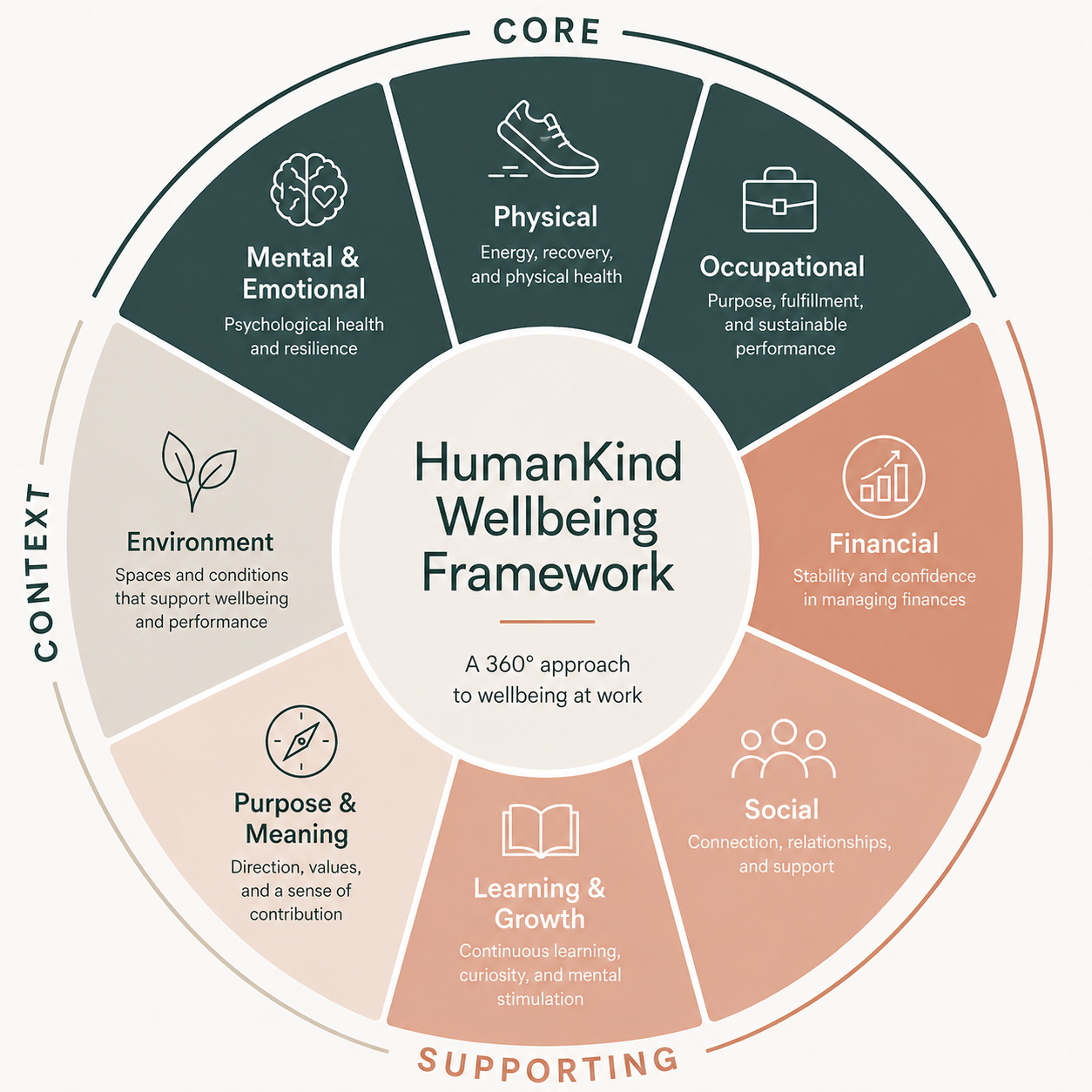
What Are Workplace Wellness Programs - Really?
It All Begins Here
Workplace wellness programs are often described as initiatives designed to support employee health.
Traditionally, this has included things like:
Gym memberships or wellness allowances
Health screenings
Step challenges or fitness campaigns
Access to mental health apps or coaching
These programs were built on a simple idea: healthier employees perform better.
And while that still holds true, the definition of workplace wellness is evolving.
From perks to everyday work
Today, wellbeing at work is no longer limited to what is offered—it is shaped by how work is experienced.
Employees are navigating:
Increasing cognitive demands
Blurred boundaries between work and personal life
Continuous change driven by digitalization and AI
Higher expectations for both performance and adaptability
In this context, traditional wellness programs—while valuable—are often not enough on their own.
A broader, more relevant definition
Modern workplace wellbeing includes both:
1. What organizations offer
Health and wellbeing services
Learning and development support
Access to tools and external expertise
2. How work is designed
Workload and expectations
Leadership behaviors
Team dynamics and communication
Opportunities for recovery and focus
The second is often where the biggest impact lies.
Why many programs fall short
Many organizations invest in wellbeing—but struggle to see results.
Common challenges include:
Low participation
Lack of relevance
Disconnect from daily work
Time constraints
This is not because employees don’t care about wellbeing. It’s because support often doesn’t fit into how work actually happens.
What effective wellbeing looks like today
Workplace wellness programs are becoming more:
Integrated – part of how work is structured, not separate from it
Targeted – aligned with real employee needs and challenges
Flexible – accessible across roles, schedules, and life situations
Supported by leadership – modeled and reinforced at all levels
Increasingly, organizations are also focusing on:
Energy and capacity—not just activity
Mental and emotional wellbeing—not just physical health
Adaptability in a changing economy
A shift in perspective
The most important shift is this:
Workplace wellness is no longer just about helping people cope with work.
It is about designing work in a way that people can sustain.
Final thought
Wellness programs still matter.
But their impact depends on how well they are connected to the reality of everyday work.
When done well, they don’t feel like an extra initiative.
They feel like part of a workplace that simply works better—for people and for performance.